

Mindsville Insights
Future Minds
How do we teach our children to trust their own minds in a world where AI always has an answer? This question sits at the heart of Mindsville.
As children grow up alongside AI, they will need more than information. They will need imagination, curiosity, emotional understanding and critical thinking. They will need to know how to ask better questions, how to understand their feelings, how to appreciate different perspectives and how to trust their own thinking.
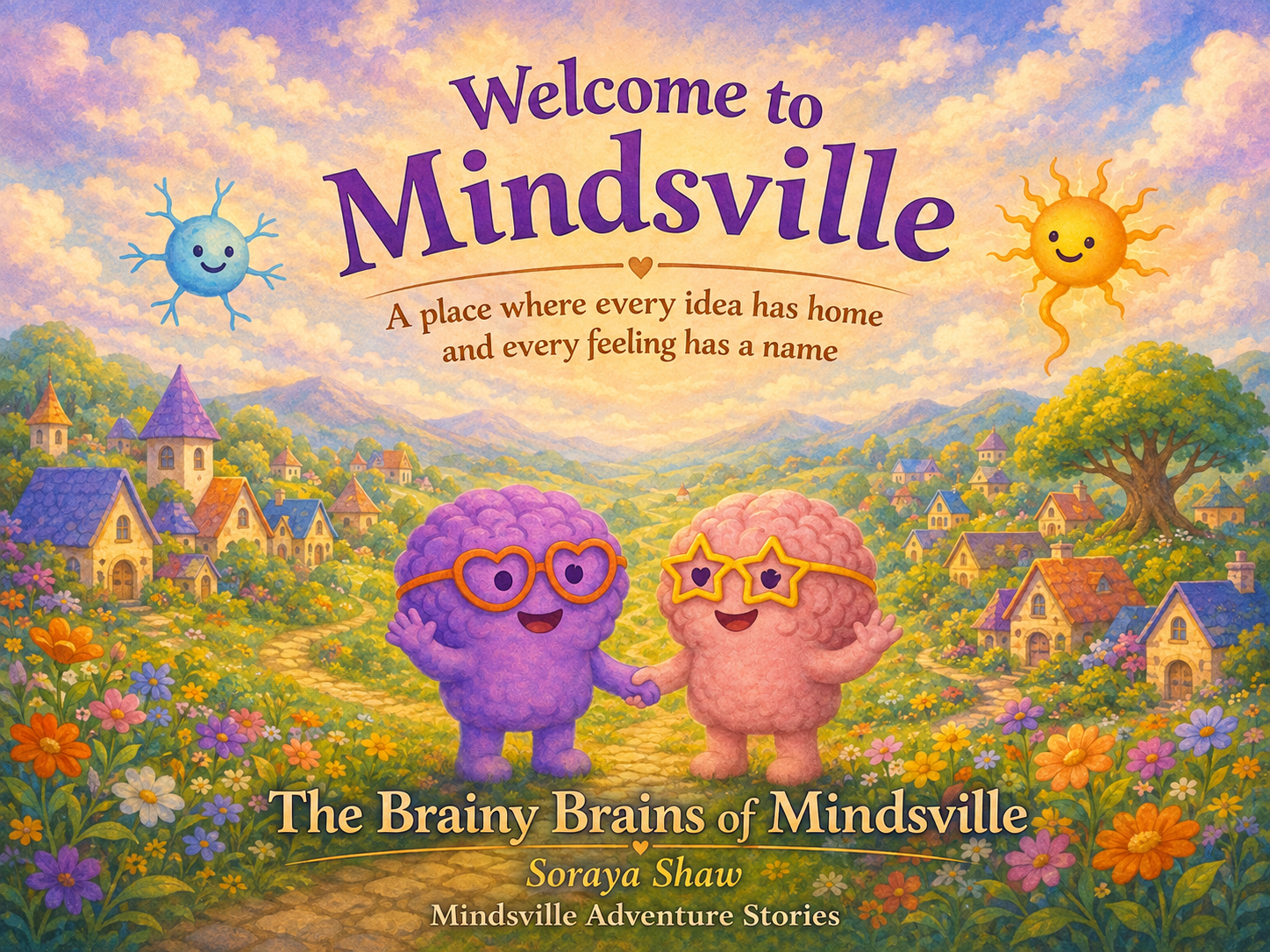
The Brainy Brains of Mindsville® introduces early brain literacy through story, helping children begin to understand how their minds work so they can think, connect and thrive more effectively.
Because Brain Capital does not begin in the boardroom. It begins in childhood.
How do we teach our children to trust their own minds ©
Hi I’m Soraya Shaw ‘Brainy Brains of Mindsville’ creator. On a recent tech panel I was chairing at the Evolve Conference in Brighton, I asked the audience a question that has stayed with me:
How do we teach our children to trust their own minds in a world where AI always has an answer?
It is a question I think every parent, teacher, leader and policy-maker will have to sit with.
Our children are growing up in a world where answers are instant, information is abundant and technology will increasingly appear confident, fluent and persuasive. We cannot hold children back from that world, nor should we try to. But we do need to guide them through it.
For me, there are three human capabilities that matter deeply.
The first is play.
Children need time to play, imagine, invent, make up stories, create worlds and follow ideas that do not have a fixed outcome. Play is not a soft extra in childhood. It is one of the ways children begin to build the neural foundations for creativity, flexibility and possibility. Before a child can innovate as an adult, they need the freedom to imagine as a child.
The second is curiosity.
In a world where new fast evolving tech can provide an answer quickly, children need to learn how to ask better questions. They need to wonder, challenge, explore and not accept everything as a given. Curiosity is not just about learning more facts. It is about developing a mind that stays open, interested and alive to possibility.
The third is critical thinking.
Children will need to learn how to pause, reflect, compare, question and think more deeply about the answers they are given. AI may provide information, suggestions and solutions, but children still need to develop judgement. They need to understand that intelligence is not only about receiving an answer. It is also about knowing what to do with it.
This is why early brain literacy matters. If children can begin to understand how their minds work, how feelings shape reactions, how thoughts can be questioned, how different brains see the world differently, then they are not simply preparing for school. They are beginning to build the foundations of Brain Capital.